In my never ending quest to write about album covers I love and Frank Sinatra I offer this new “two for one” post.
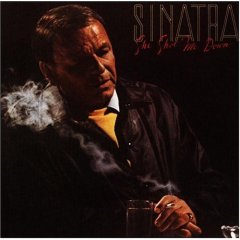
The album is “She Shot Me Down” featuring the striking cover photo by Ed Thrasher. This photo finds our favorite saloon singer, and patron, taking stock of his life at age 65. That imaginary retirement age that claimed an earlier generation. Frank commands his usual spot at the bar. As is the case no one else takes their spot until he’s taken his. You don’t know if he’s drinking a double, a triple or the bartender just pored until he got the nod. When he lights up a smoke no one is thinking about ordinances or second hand smoke. He’s got a story to tell, if not a torch to be drowned. His eyes appear to be closed.
Sometimes they call them beer joints, sometimes a lounge or even the “hotel bar.” Names make no difference because whenever he’s at a bar it’s still a saloon and it’s New Jersey back in the day. He can recall long nights, decades ago when critics said he would fade before the next baseball season started. He can still hear the whispers when he closes those blue eyes. A couple of drinks, a few unfiltered Camels and they float away with the smoke. Billie Holiday singing “These Foolish Things” on the jukebox, a girl crying in the booth by the door and the sound of dice hitting the baseboard in the back room make him think he’s home again. The old gang won’t be there tonight though, but somewhere along the way he’ll have one for them. And then one for the road.
The time is now 1981 and he was just a year removed from recording his final signature song “New York, New York.” It would be the final shot as a chart artist in these rapidly changing times. (He would of course continue to find success right up to the end with his misguided “Duets” albums. The ones where he offers other performers the chance to have their name and voice next to his on something people would pay money for. The commerce end of the deal went off without a hitch, the musical history part didn’t pay as well though.)
Anyway, back to the scene at hand. This album of booze soaked melancholy was released in a year that found Christopher Cross, Air Supply, Sheena Easton, Rick Springfield and Hall & Oates polluting the airwaves of pop music. It was enough to drive anyone to drink and smoke. He had seen the best of music come and go. He had bested all of his generation, withstood rock and roll, made it through the sixties and even found some peace of mind in the seventies. The punk movement and the current wave of pop acts though were too much to overcome even if he wanted to. Most were passé before they released their first recordings. Music was moving into a “flavor of the month” mentality, no one was thinking career, just hits and little else.
It had been nearly ten years since his original retirement that he grew bored with after a few hundred rounds of golf. He was a singer, and singers don’t retire. They cut back, choose their songs a bit more carefully and try not to do any damage to any legacy they have acquired.
Gordon Jenkins was back on board as arranger for this last round and they picked up like only a moment or two had passed. (Don Costa, who also produces, and Nelson Riddle contribute one track each to round it out) The centerpiece of the album is the title track. A pop hit for Cher written by husband at the time Sonny Bono. It’s a strange metaphoric tale that incredibly carried no real weight in her poppy rendition. In the hands of a master singer it speaks volumes in its slight verses and eerie chorus. Jenkins does his part and gives Frank a musical bed to float this jaded tale on. Daughter Nancy had also recorded a version of this one and possibly offered the old man the direction to take this tune. With this version you really have to credit Sonny for writing such a compelling song that took fifteen or so years to be fully appreciated.
Other tracks include and update of “Thanks For The Memories” that rescues it from novelty, a recent Sonheim tune and finishes with a stunning medley of “The Gal That Got Away / It Never Entered My Mind” arranged by Nelson Riddle and harkening back to another time and place like only he can.
At a lean nine tracks and thirty seven minutes this one merits some careful and poignant listening that gets better with each spin. The songs are all told from the vantage point of the guy a couple of stools down who’s dispensing wisdom to those crowded at the bar. By the end of the evening, and the album he’s talking to only the bartender and himself.
The album is “She Shot Me Down” featuring the striking cover photo by Ed Thrasher. This photo finds our favorite saloon singer, and patron, taking stock of his life at age 65. That imaginary retirement age that claimed an earlier generation. Frank commands his usual spot at the bar. As is the case no one else takes their spot until he’s taken his. You don’t know if he’s drinking a double, a triple or the bartender just pored until he got the nod. When he lights up a smoke no one is thinking about ordinances or second hand smoke. He’s got a story to tell, if not a torch to be drowned. His eyes appear to be closed.
Sometimes they call them beer joints, sometimes a lounge or even the “hotel bar.” Names make no difference because whenever he’s at a bar it’s still a saloon and it’s New Jersey back in the day. He can recall long nights, decades ago when critics said he would fade before the next baseball season started. He can still hear the whispers when he closes those blue eyes. A couple of drinks, a few unfiltered Camels and they float away with the smoke. Billie Holiday singing “These Foolish Things” on the jukebox, a girl crying in the booth by the door and the sound of dice hitting the baseboard in the back room make him think he’s home again. The old gang won’t be there tonight though, but somewhere along the way he’ll have one for them. And then one for the road.
The time is now 1981 and he was just a year removed from recording his final signature song “New York, New York.” It would be the final shot as a chart artist in these rapidly changing times. (He would of course continue to find success right up to the end with his misguided “Duets” albums. The ones where he offers other performers the chance to have their name and voice next to his on something people would pay money for. The commerce end of the deal went off without a hitch, the musical history part didn’t pay as well though.)
Anyway, back to the scene at hand. This album of booze soaked melancholy was released in a year that found Christopher Cross, Air Supply, Sheena Easton, Rick Springfield and Hall & Oates polluting the airwaves of pop music. It was enough to drive anyone to drink and smoke. He had seen the best of music come and go. He had bested all of his generation, withstood rock and roll, made it through the sixties and even found some peace of mind in the seventies. The punk movement and the current wave of pop acts though were too much to overcome even if he wanted to. Most were passé before they released their first recordings. Music was moving into a “flavor of the month” mentality, no one was thinking career, just hits and little else.
It had been nearly ten years since his original retirement that he grew bored with after a few hundred rounds of golf. He was a singer, and singers don’t retire. They cut back, choose their songs a bit more carefully and try not to do any damage to any legacy they have acquired.
Gordon Jenkins was back on board as arranger for this last round and they picked up like only a moment or two had passed. (Don Costa, who also produces, and Nelson Riddle contribute one track each to round it out) The centerpiece of the album is the title track. A pop hit for Cher written by husband at the time Sonny Bono. It’s a strange metaphoric tale that incredibly carried no real weight in her poppy rendition. In the hands of a master singer it speaks volumes in its slight verses and eerie chorus. Jenkins does his part and gives Frank a musical bed to float this jaded tale on. Daughter Nancy had also recorded a version of this one and possibly offered the old man the direction to take this tune. With this version you really have to credit Sonny for writing such a compelling song that took fifteen or so years to be fully appreciated.
Other tracks include and update of “Thanks For The Memories” that rescues it from novelty, a recent Sonheim tune and finishes with a stunning medley of “The Gal That Got Away / It Never Entered My Mind” arranged by Nelson Riddle and harkening back to another time and place like only he can.
At a lean nine tracks and thirty seven minutes this one merits some careful and poignant listening that gets better with each spin. The songs are all told from the vantage point of the guy a couple of stools down who’s dispensing wisdom to those crowded at the bar. By the end of the evening, and the album he’s talking to only the bartender and himself.
“…bang bang, that awful sound…”